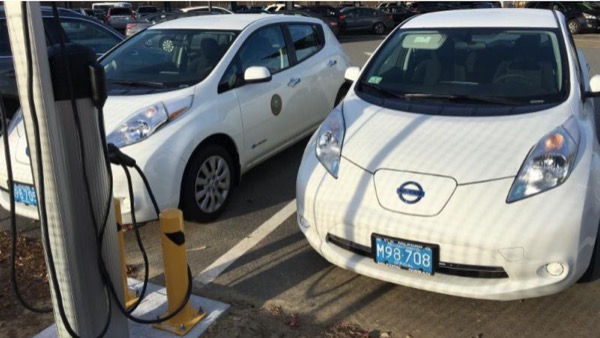
Emissions, anyone? In Melrose, transportation accounts for a whopping 39% of our greenhouse gas emissions. Electric vehicles, in combination with renewable, carbon-free electricity generation, can dramatically reduce your greenhouse gas emissions because they have lower lifecycle emissions than gas-powered cars, even after accounting for extra emissions from battery manufacturing. (Buy 100% renewable electricity at a small premium with Melrose Community Power 100% Local Green.)
With a renewably-powered EV, the only source of emissions comes from the manufacturing process. If the electricity comes from fossil fuels, driving an EV is obviously not entirely pollution free. Still, according to the Union of Concerned Scientists, EVs and plug-in hybrids have a much smaller carbon footprint than conventional cars no matter what the source of the electricity.
There are a lot of great choices on the market right now, from all-electric to hybrids with plug-in options. They’re fun to drive with their great acceleration and low center of gravity which improves handling. And they’re cheaper to run. According to the US Department of Energy, electric vehicles can save as much as $1,200 per year in fuel costs. On top of that, EVs have fewer moving parts and are therefore much cheaper to maintain: they do not need oil changes, and have no transmission fluids, fuel pumps, timing belts and many other moving parts.
Range anxiety? Fully electric vehicles are constrained by their battery capacity, but the battery range improves by the year. For example, the popular Tesla Model 3 has a range of up to 358 miles, and the network of charging stations keeps expanding, with many apps that help you locate public charging stations and whether they have a free charger available in real time. There are, for instance, over 1,300 Tesla Supercharger Stations in North America with plans to triple that amount in 2 years (these can’t be used by other makes, though). Most chargers are located conveniently at restaurants or roadside rest stops. Melrose has 16 public charging stations throughout the city, and some of the larger apartment buildings have begun adding EV chargers for their tenants and guests.
You can plug your car into any standard 120V outlet, but many EV owners install a Level II 240 volt charger at home, which speeds charging time up to 6x. Equipment plus installation of these chargers cost in the range of $1,000 to $1,200 and the cost is tax deductible. In addition, National Grid will reimburse residential customers up to $700 for installation of the charger, and customers with a low-income discount rate (R-2) will be reimbursed even more, plus receive a rebate for the charger. Learn more about National Grid’s Residential EV Charging Infrastructure Program here.
Rebates. Qualifying battery electric vehicles and fuel cell electric vehicles are eligible for a Massachusetts rebate of $1,500 – $3,500 through the MOR-EV program. Many electric vehicles also qualify for federal income tax credits of up to $7,500. The amounts depend on the battery size of the vehicle, the model, and, of course, your tax liability. Also, the Inflation Reduction Act, which was signed into law on August 16, 2022, imposes some strict “Made In America” requirements that make it difficult to determine whether an electric vehicle is elegible for a federal tax credit. On April 17, 2023 the IRS released the criteria that electric vehicles must meet in order to receive the federal tax credit. Check here for the latest on which vehicles qualify, and the dealer will advise you as well. Tax credits and rebates are available to car purchasers only.